


How to Reduce or Eliminate IRMAA Surcharges on Medicare Premiums: 2026 Guide
By Michael Haman, CFP®
Originally published February 27, 2025 | Updated for September 2026
What Are IRMAA Surcharges and Why Should You Care?
IRMAA, which stands for Income-Related Monthly Adjustment Amounts, significantly impacts high-income earners on Medicare but rarely receives adequate coverage in retirement planning discussions. If you're approaching Medicare age or already enrolled, understanding these surcharges could save you thousands of dollars annually.
This guide explains what IRMAA is, how it's calculated, and provides actionable strategies to legally reduce or eliminate these surcharges in 2026 and beyond. If you're a high-income earner who doesn't enjoy paying hundreds of extra dollars monthly for Medicare, this information is essential for your retirement planning. If you're a high-income earner who DOES enjoy paying hundreds of extra dollars monthly for Medicare, maybe consider getting your healthcare Power of Attorney documents in order.
Understanding IRMAA's Impact on Your Medicare Costs
IRMAA applies to Medicare Parts B and D premiums based on your modified adjusted gross income (MAGI) from two years prior. For 2026 premiums, your 2024 tax return is used to determine surcharges.
Medicare offers two primary enrollment paths:
- Original Medicare: Typically includes Medicare Part A (usually premium-free), Part B (standard medical coverage), optional Medicare supplement (Medigap), and Part D (prescription drug coverage)
- Medicare Advantage: Combines various coverages into a single plan
IRMAA surcharges apply to both Part B and Part D premiums regardless of which enrollment path you choose — even if your Medicare Advantage plan has a $0 premium.
2026 Medicare Part B IRMAA Surcharges
| If your yearly income in 2024 was | You pay monthly (in 2026) |
|---|---|
| Individual filers | |
| $109,000 or less | $202.90 |
| Above $109,000 up to $137,000 | $284.10 |
| Above $137,000 up to $171,000 | $405.80 |
| Above $171,000 up to $205,000 | $527.50 |
| Above $205,000 and less than $500,000 | $649.20 |
| $500,000 or above | $689.90 |
| Joint filers | |
| $218,000 or less | $202.90 |
| Above $218,000 up to $274,000 | $284.10 |
| Above $274,000 up to $342,000 | $405.80 |
| Above $342,000 up to $410,000 | $527.50 |
| Above $410,000 and less than $750,000 | $649.20 |
| $750,000 and above | $689.90 |
| Married filing separately | |
| $109,000 or less | $202.90 |
| Above $109,000 and less than $391,000 | $649.20 |
| $391,000 and above | $689.90 |
2026 Medicare Part D IRMAA Surcharges
| If your yearly income in 2024 was | Additional amount you pay monthly (in 2026) |
|---|---|
| Individual filers | |
| $109,000 or less | $0 (just your plan premium) |
| Above $109,000 up to $137,000 | $14.50 + your plan premium |
| Above $137,000 up to $171,000 | $37.50 + your plan premium |
| Above $171,000 up to $205,000 | $60.40 + your plan premium |
| Above $205,000 and less than $500,000 | $83.30 + your plan premium |
| $500,000 or above | $91.00 + your plan premium |
| Joint filers | |
| $218,000 or less | $0 (just your plan premium) |
| Above $218,000 up to $274,000 | $14.50 + your plan premium |
| Above $274,000 up to $342,000 | $37.50 + your plan premium |
| Above $342,000 up to $410,000 | $60.40 + your plan premium |
| Above $410,000 and less than $750,000 | $83.30 + your plan premium |
| $750,000 and above | $91.00 + your plan premium |
| Married filing separately | |
| $109,000 or less | $0 (just your plan premium) |
| Above $109,000 and less than $391,000 | $83.30 + your plan premium |
| $391,000 and above | $91.00 + your plan premium |
The Real Financial Impact of IRMAA
What does this mean in practical terms? If you're a married couple with MAGI above $750,000, you could pay:
- Part B: Additional $487.00/month per person ($689.90 − $202.90) = $11,688/year for a couple
- Part D: Additional $91.00/month per person = $2,184/year for a couple
That's nearly $13,900 in additional Medicare premiums annually just because of your income level.
It's important to note that IRMAA surcharges are "cliff penalties" — if you're just $1 over a threshold, you pay the entire higher amount. Crossing even the first threshold costs a single filer an extra $974 per year in Part B premiums alone (roughly $2,300 for a couple once Part D is included). This makes strategic income planning crucial for those near these thresholds.
Making matters trickier, the IRMAA cliffs and the federal tax brackets were apparently designed by people who never met each other — the cliffs land in the middle of tax brackets, not at their edges. So we built a map. It assumes you take the standard deduction and have no unusual MAGI adjustments, so MAGI equals gross income. The dashed red lines are the IRMAA cliffs; notice where they fall relative to the bracket boundaries:
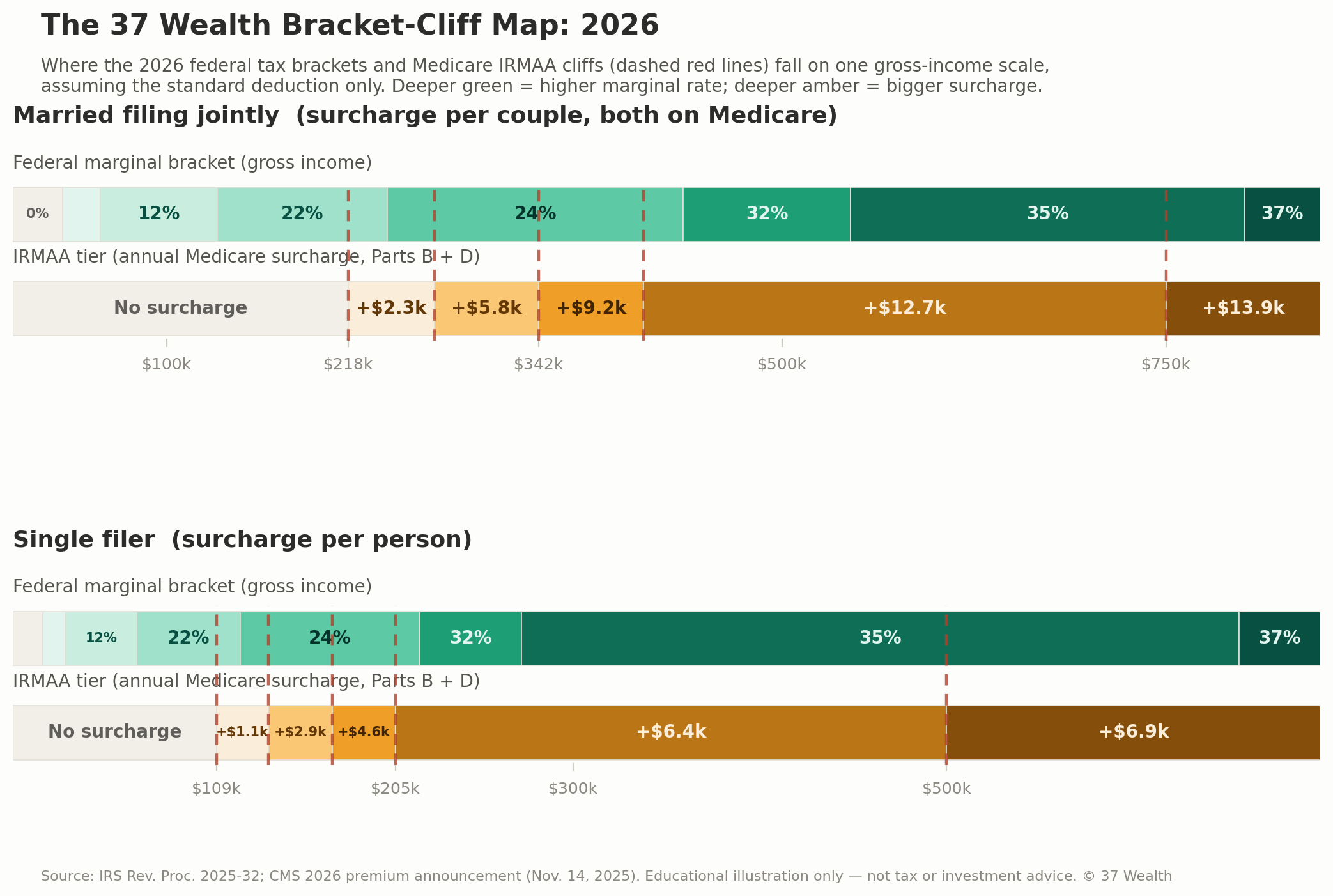
Assumes the 2026 standard deduction only ($32,200 joint / $16,100 single, no age-65 additions), no above-the-line adjustments, and no tax-exempt interest, so MAGI equals gross income. Joint surcharge amounts assume both spouses enrolled in Medicare Parts B and D; single amounts are per person. IRMAA uses a two-year lookback: income realized in 2026 affects Medicare premiums in 2028 under 2028 thresholds, so treat this map as a planning approximation.
Notice what the map reveals: for a joint filer, the first IRMAA cliff ($218,000 of income) sits inside the 22% bracket, which runs to $243,600 of gross income — so the common advice to "convert to the top of the 22% bracket" already triggers a surcharge for a Medicare couple. And three more cliffs ($274,000, $342,000, and $410,000) land inside the 24% bracket. The tax code and Medicare simply don't line up, which is exactly why IRMAA planning has to happen alongside tax planning, not after it.
What's New for 2026
The 2026 Medicare premium amounts and IRMAA income thresholds have been adjusted from 2025 levels:
- The standard Part B premium has increased from $185.00 (2025) to $202.90 (2026) — a 9.7% increase, one of the largest in years
- The Part B annual deductible rose from $257 (2025) to $283 (2026)
- Income thresholds have been raised modestly (about 2.8%) to account for inflation: individual lowest threshold $106,000 (2025) → $109,000 (2026); joint lowest threshold $212,000 (2025) → $218,000 (2026)
- Maximum IRMAA surcharges have increased: maximum Part B surcharge $443.90 (2025) → $487.00 (2026) per person monthly; maximum Part D surcharge $85.80 (2025) → $91.00 (2026) per person monthly
- The top income bracket ($500,000 individual / $750,000 joint) remains frozen by law and is not eligible for inflation indexing until 2028
Because the surcharge dollar amounts grew roughly 9–10% while the income thresholds only moved about 3%, crossing a threshold costs more in 2026 than it ever has. Retirees paying IRMAA also get no "hold harmless" protection, so they absorb the full premium increase regardless of their Social Security cost-of-living adjustment. One additional note: for beneficiaries below IRMAA levels who have their premium deducted from Social Security, a "hold harmless" rule prevents a Part B increase from reducing their net Social Security check. That protection never applies to anyone paying IRMAA, anyone new to Medicare, or anyone who hasn't yet filed for Social Security — which describes many high-income retirees on all three counts.
Understanding MAGI for IRMAA Calculations
Modified Adjusted Gross Income (MAGI) for IRMAA purposes includes:
- Adjusted Gross Income (AGI) from line 11 of your Form 1040
- Plus any tax-exempt interest income
Your AGI includes all income except "above the line" adjustments such as:
- HSA contributions
- Deductible IRA contributions
- Student loan interest
- Self-employed business deductions
Standard and itemized deductions do not reduce your MAGI as they occur "below the line."
5 Effective Strategies to Reduce IRMAA Surcharges
1. Strategic Income Diversification
Combine multiple retirement income sources to carefully manage your taxable income:
- Roth IRA distributions: Tax-free withdrawals don't count toward MAGI
- Principal withdrawals from taxable accounts: Only the capital gains portion impacts MAGI
- Tax-loss harvesting: Offset capital gains with losses in taxable accounts
- Strategic withdrawal sequencing: Rather than the standard "taxable first, then traditional, then Roth" approach, consider blending withdrawals annually to stay under IRMAA thresholds
Example: Instead of taking $120,000 from your traditional IRA (all taxable), consider taking $80,000 from traditional IRA and $40,000 from Roth IRA to potentially stay in a lower IRMAA bracket.
2. Roth Conversion Planning
Strategically converting traditional IRA funds to Roth IRAs before Medicare enrollment can significantly reduce future RMDs and IRMAA exposure:
- Pay taxes now at potentially lower rates
- Reduce future Required Minimum Distributions that could push you into higher IRMAA brackets
- Create tax diversification for flexibility in retirement income planning
Keep the two-year lookback in mind: a Roth conversion completed in 2026 affects your Medicare premiums in 2028. And because Medicare examines the return from two years before enrollment, income you report at age 63 shapes your very first premium at 65 — the planning window opens earlier than most people think.
For more details on Roth conversion strategies, see our comprehensive guide: Is a Roth Conversion Right for You?
Should You Ever Pay IRMAA on Purpose?
There are occasions where doing Roth conversions makes sense, even if it pushes you into IRMAA surcharges or a higher IRMAA surcharge bracket than you would have been in without one. The question is: does the present value of the plan improvement exceed the IRMAA surcharge amount? In many cases, especially when tax-efficient estates are a priority, this answer can be yes and thus justify paying such surcharges in exchange for lower taxes and lower surcharges later on.
3. Strategic Asset Location
Place investments in the most tax-efficient account types:
- Tax-efficient investments (index funds, ETFs) in taxable accounts
- Income-producing investments (bonds, REITs) in tax-advantaged accounts
- High-growth investments with long holding periods in Roth accounts
This strategy reduces annual taxable income while maintaining your desired asset allocation. If you're constantly realizing large capital gains that are independent of your actions (for example, you own a mutual fund and don't sell to realize the gain), between now and year end is a great time to evaluate what you own and if it would make sense (from a tax and asset allocation perspective) to make adjustments.
4. Qualified Charitable Distributions (QCDs)
If you're 70½ or older:
- Donate directly from your IRA to qualified charities (up to $111,000 per person in 2026, adjusted annually for inflation)
- QCDs count toward your Required Minimum Distribution
- The distribution isn't included in your AGI, potentially lowering your IRMAA bracket
- Provides charitable impact while reducing your tax burden
5. Social Security Timing and Medicare Enrollment Coordination
- Delaying Social Security can reduce IRMAA in early retirement years
- Coordinate large income events (like Roth conversions) with Medicare enrollment timing (if you're retired and don't have active health coverage, this won't be an option)
- Consider healthcare coverage options before Medicare to facilitate strategic income planning
When to Request an IRMAA Reconsideration
Medicare allows you to request a reconsideration of your IRMAA determination if you've experienced a "life-changing event" that reduced your income, including:
- Marriage, divorce, or spousal death
- Work stoppage or reduction (retirement is the obvious example)
- Loss of income-producing property
- Loss of pension income
- Employer settlement payment
File Form SSA-44 with documentation to potentially reduce or eliminate your IRMAA surcharge midyear rather than waiting for your next tax return to be processed. Note that one-time income spikes like a home sale, capital gains, or a Roth conversion do not qualify; those simply age out after the two-year window.
Work With a Professional for Optimal Results
IRMAA planning is complex and requires coordination between:
- Tax planning
- Investment management
- Social Security claiming strategy
- Medicare enrollment timing
- Required Minimum Distribution planning
If you're approaching Medicare age or already subject to IRMAA surcharges, work with a financial advisor and tax professional who understand these complex interactions to develop a comprehensive strategy.
At 37 Wealth, we specialize in helping clients navigate these retirement planning challenges. Contact us for a personalized IRMAA reduction strategy.
This article is meant for educational purposes only. It should not be considered investment advice, nor does it constitute a recommendation to take a particular course of action. Please consult with a financial professional or Tax Professional regarding your personal situation prior to making any financial-related decisions.
The Bracket-Cliff Map above is an educational illustration based on 2026 figures and simplified assumptions (standard deduction only, MAGI equal to gross income); your actual tax and Medicare premium situation will differ.
Traditional IRA account owners have considerations to make before performing a Roth IRA conversion. These primarily include income tax consequences on the converted amount in the year of conversion, withdrawal limitations from a Roth IRA, and income limitations for future contributions to a Roth IRA. In addition, if you are required to take a required minimum distribution (RMD) in the year you convert, you must do so before converting to a Roth IRA.
No strategy assures success or protects against loss.
Sources: